Addresses
Type of place
Railway station
Period
Postwar 1945-1960
Style
Queenslander
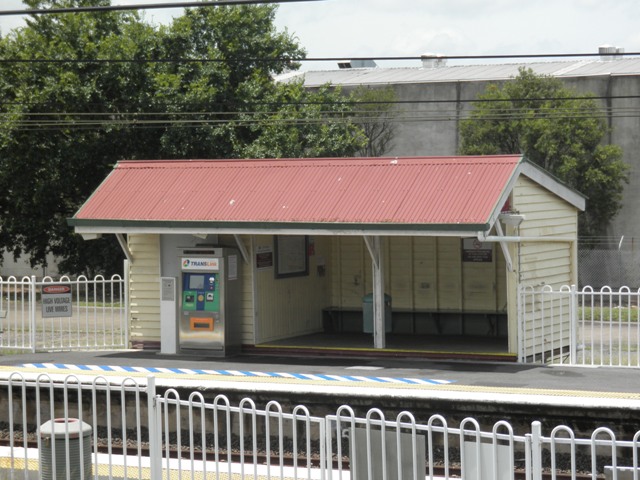

This is an image of the local heritage place known as Rocklea Railway Station
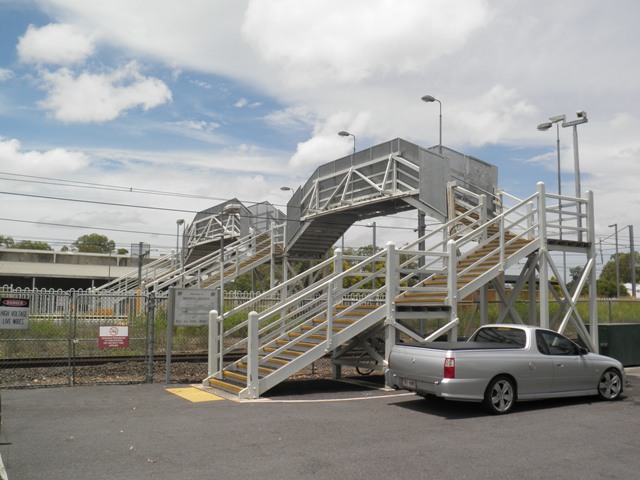
This is an image of the local heritage place known as Rocklea Railway footbridge
Rocklea Railway Station & footbridge
Addresses
Type of place
Railway station
Period
Postwar 1945-1960
Style
Queenslander
The Rocklea railway station and footbridge are significant as evidence of the establishment and subsequent expansion of rail transport services from South Brisbane to Beenleigh. As part of that rail system, Rocklea station has served the local community's transport needs for more than a century. The ticket office, constructed in 1950 is a good example of the precast concrete buildings that Queensland Rail erected at stations since 1919, while the double span timber footbridge is one of a limited number of such bridges on Brisbane metropolitan railway lines.
Lot plan
L10_SP122190
Key dates
Local Heritage Place Since —
Date of Citation —
Construction
Roof: Corrugated iron;Walls: Timber
Criterion for listing
(A) Historical; (B) Rarity; (B) Rarity; (D) RepresentativeInteractive mapping
Lot plan
L10_SP122190
Key dates
Local Heritage Place Since —
Date of Citation —
Construction
Roof: Corrugated iron;Walls: Timber
Criterion for listing
(A) Historical; (B) Rarity; (B) Rarity; (D) RepresentativeInteractive mapping
History
Rocky Water Holes was settled in the 1850s as a stopping place for coaches on the journey between Brisbane and Ipswich. Within a decade the small township which developed on high ground to the south of where Ipswich Road crossed Rocky Water Holes Creek boasted two hotels and a number of stores. As a consequence of demand for a railway to service agricultural areas to the south of Brisbane, the first section of the South Coast line between Yeerongpilly and Beenleigh was opened in 1885. This necessitated the construction of a rail bridge across Rocky Water Holes Creek and a station near the settlement of the same name. According to John Kerr in Destination South Brisbane, this station was named the shorter 'Rocklea' following a suggestion by the then Traffic Manager. Eventually the district and suburb became known by the name.
The rail line constructed in 1884/85 was a single line which initially received two 'up' and two 'down' services per day. In 1886 a suburban rail service between South Brisbane and Rocklea was introduced. By 1888 as many as eight trains per day terminated at Rocklea, which by this time consisted of both station and siding.
On 17 January 1925 at Rocklea the first sod was turned in the construction of a standard gauge line connecting Brisbane and Sydney via Kyogle. A third line was built from South Brisbane to Salisbury (the next station outbound from Rocklea) beside the existing track. Thereafter an entirely new route to the border with New South Wales was established. This interstate link was opened on 27 September 1930. It is possible that the double-arch timber footbridge (clearly visible in 1946 aerial photographs) was either constructed or extended at this time to ensure passenger safety when crossing from the platforms across the standard gauge line to the residential and commercial areas of Rocklea.
Duplication of the railway occurred in 1951, although from its position as a terminus both 'inbound' and 'outbound' sidings appear to have been constructed at Rocklea far earlier than this.
The Station's ticket office was constructed circa 1950. It is built from precast concrete slabs to a design that had been in use since 1919.
The double span footbridge is built to the standard design used by Queensland Rail throughout the twentieth century and is of timber frame construction with timber treads, deck and landings. This type of footbridge is now familiar only on the Brisbane metropolitan lines and the Ipswich to Toowoomba Main Line.
On 2 February 1975 vandals set fire to the station office. According to the Courier-Mail, "The fire wrecked the concrete-block station, causing tens of thousands of dollars damage. The heat was so intense it burned a hole through the metal roof." Bondwood huts were located on the station platform until repairs were completed.
Description
The earliest building on this site is a shelter the design of which is believed to date from circa 1914. It is a timber weatherboard, skillion roofed open shelter with attached store on the station’s outbound platform. The awning is of separated skillion design with ladder frame brackets and struts. The building sits on timber stumps.
The footbridge is a standard double span design footbridge (one span over standard gauge track and one over duplicated narrow gauge tracks). It is of timber frame construction on concrete pad footings. The treads, deck and landings are all timber.
The passenger station is of precast concrete design with adaptations. The flat roof of the building is supported by Oregon pine beams. The roof cantilevers to provide shelter for the platform. Some windows are timber casement, others aluminium. The building encompasses an open waiting area, office and toilets.
Statement of significance
Relevant assessment criteria
This is a place of local heritage significance and meets one or more of the local heritage criteria under the Heritage planning scheme policy of the Brisbane City Plan 2014. It is significant because:
References
-
A heritage management report, Metropolitan South Beenleigh Line, Buchanan Architects, Queensland Rail files
-
Brisbane City Council Water Supply & Sewerage Detail Plans
-
Clarke, Robyn and Tom Price. Tapestry of time: A history of the Rocklea State School and the district, Rocklea: Centenary Committee of the Rocklea State School, 1989
-
Environmental Protection Agency
-
JOL Estate Map Collection and photographic collection
-
Kerr, John. Destination South Brisbane. Australian Railway Historical Society, Brisbane, 1984
-
Lawson, Ronald Brisbane in the 1890s: A Study of an Australian Urban Society. St Lucia U of Q Press, 1973
-
Queensland Post Office Directories
-
Survey of railway assets, Andrew Ward, Architectural Historian, Queensland Rail files
Citation prepared by — Brisbane City Council (page revised January 2026)