Addresses
Type of place
Cottage, Hall
Period
Federation 1890-1914
Style
Queenslander
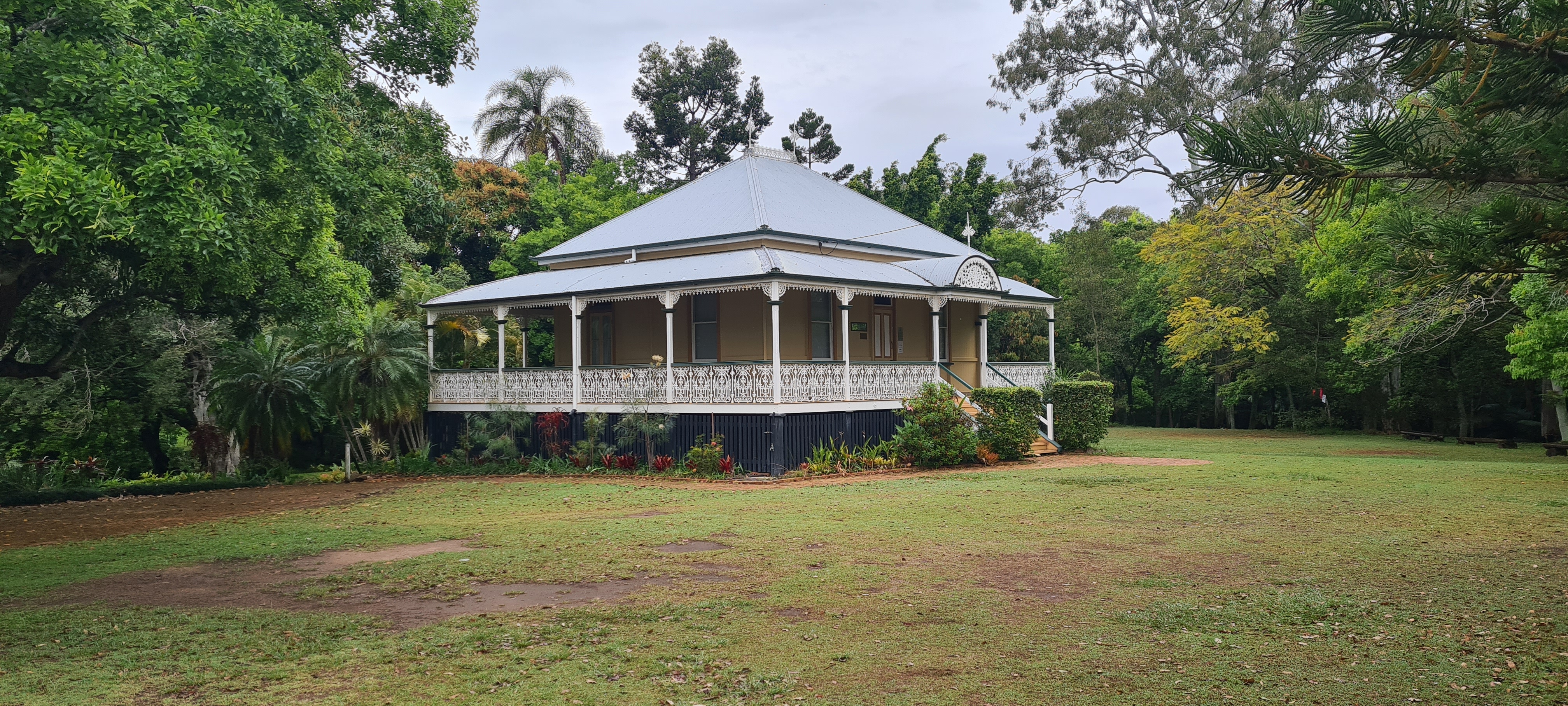

Elevation from Tingal Rd
Shire Clerk's Cottage
Addresses
Type of place
Cottage, Hall
Period
Federation 1890-1914
Style
Queenslander
The Shire Clerk’s Cottage is a Colonial Short-Ridge Queenslander built in 1890 as a residence for the Wynnum Town Clerk in the grounds of what is now Wynnum Municipal Reserve. Set in a picturesque garden, it was built during a period of significant development for the area’s local government. It is associated with Joe Sands, a long-serving official of successive local authorities in the area, who lived here with his family between 1907 and 1935. Sands is credited with influencing Wynnum's growth through improvements to its roads, drains, bridges, parklands and waterfront areas. The site has a long-standing connection with the Wynnum community and is considered a local landmark. The grounds of the Shire Clerk’s Cottage are also the location of the Pamphlett Memorial, erected by the Wynnum Manly and Districts Historical Society in 1993.
Lot plan
L624_W4212; L69_W4212
Key dates
Local Heritage Place Since —
Date of Citation —
Construction
Roof: Corrugated iron;Walls: Timber
People/associations
Joe Sands (Occupant)Criterion for listing
(A) Historical; (D) Representative; (E) Aesthetic; (G) Social; (H) Historical associationInteractive mapping
Lot plan
L624_W4212; L69_W4212
Key dates
Local Heritage Place Since —
Date of Citation —
Construction
Roof: Corrugated iron;Walls: Timber
People/associations
Joe Sands (Occupant)Criterion for listing
(A) Historical; (D) Representative; (E) Aesthetic; (G) Social; (H) Historical associationInteractive mapping
History
The Shire Clerk’s Cottage and Pamphlett Memorial are located at 245 Tingal Road, Wynnum. The Shire Clerk’s Cottage dates to the 19th Century and the early municipal development of Wynnum, while the memorial highlights the work of the Wynnum Manly and Districts Historical Society in commemorating aspects of the suburb's history.
The Shire Clerk's Cottage
Local government was introduced into the Wynnum area with the establishment of the Kianawah Divisional Board in 1888. The Divisional Board operated from rented premises in King Street Wynnum, but in 1889 organised plans for a public hall, an office and a clerk’s residence. There is an indication that these structures were intended to be erected on property in King Street, but the Board could not agree on the location. The decision was so long delayed that prominent Brisbane architect G.W.C. Wilson, who had prepared the building plans, commenced legal proceedings to recover his fees and ultimately became insolvent due to this action.
The Queensland Government set aside approximately 8,000m2 of land on Tingal Road for the Board’s use, which was accepted. The municipal buildings were eventually designed in 1890 by architect Mark Taylor of the practice Taylor and Richer. Tenders were finally called in March 1890 for the erection of the buildings, and J.G. Gross's tender was accepted in April. The hall and clerk’s house were completed by August 1890. The former Kianawah Divisional Board was renamed the Wynnum Divisional Board in 1892. Ten years later, in 1902, the Wynnum Shire Council was created. Wynnum was declared a municipality in 1913. The property came under the control of the Brisbane City Council upon the amalgamation of the shires to form Greater Brisbane in 1925.
The house is most strongly associated with Joe Sands, a long-serving official of successive local authorities in the area. He and his family were residents in the cottage between 1907 and 1935. He combined the duties of Town Clerk and Engineer and is credited with significant influence on the district's growth and on the provision of roads, drains, bridges, parklands and waterfront improvements.
In 1980, the cottage was leased by the adjoining Waterloo Bay Leisure Centre, The Centre subsequently established a restoration committee and, with the support of local organisations and residents and a Commonwealth employment program, the cottage was fully restored in 1984. It continues to be used as a venue for markets, weddings and other social gatherings.
The Pamphlett Memorial
The grounds of the Shire Clerk’s Cottage have also become the venue for a monument established by the Wynnum Manly and Districts Historical Society. Established in 1988, the Wynnum Manly and Districts Historical Society have made a concerted effort to erect monuments commemorating key events in the history of Wynnum. The Pamphlett Memorial commemorates the story of Thomas Pamphlett, Richard Parsons and John Finnegan and their journey through the Wynnum area after being wrecked on Moreton Island in 1823. Pamphlett and Finnegan were subsequently discovered by the New South Wales Surveyor-General John Oxley and the crew of the Mermaid, who were sent to explore the coast of what would become Queensland as an alternative site for a penal settlement. This event led to the discovery of the Brisbane River and the eventual establishment of the Moreton Bay Penal Settlement (Brisbane). Member Jack Sands, the son of Joe Sands, played a central role in securing the monument's erection. The monument was unveiled on 6 June 1993 by Lord Mayor Jim Soorley to mark the 170th anniversary of Pamphlett, Parsons and Finnegan’s journey.
Description
The former Shire Clerk’s Cottage is a timber-framed, iron-roofed Colonial Short-Ridge Queenslander built in 1890, with a monument in the grounds of the Wynnum Municipal Reserve, located at 245 Tingal Road.
The key features of the place include the Colonial Short-Ridge cottage, its garden setting, and the adjacent Pamphlett Memorial. The house features timber fretwork and filigree verandah detailing, a short-ridge roof form, and a prominent light-coloured brick chimney with decorative corbelling. The house, with exposed stud framing to verandah walls and horizontal chamferboard cladding, is high-set, with a high-pitched, corrugated sheet-metal short-ridge roof, and is supported on timber stumps, with a battened screen to the perimeter shading an undercroft. Part of the undercroft has been infilled with brick, with openings consisting of glazing and glazed timber doors. A convex-shaped stepped verandah roof protects the western, northern and eastern sides of the house.
A striking feature of the house is the use of decorative cast iron filigree work to the verandah’s balustrade and valances beneath the verandah beam, supported by slender timber posts with decorative brackets. Filigree detailing can be found on the main roof’s ridge and finials. The principal façade of the house features timber entry stairs rising to a vaulted portico, infilled with a decorative timber fretwork screen. This leads to a central entrance with a four-panelled, low-waisted timber door and a transom window above. Openings consist of timber-framed double-hung sash windows and a glazed French door to the northern verandah. Corrugated sheet-metal skillion hoods with timber battened brackets protect the windows on the exposed side elevations. A set of timber stairs with double-railed balustrade leading to the verandah is at the rear of the house.
The house sits in the grounds of the Wynnum Municipal Reserve, which features various informal plantings, with Wynnum Creek running alongside the reserve. A red-brick pathway leads to the front of the cottage. The cottage is surrounded by well-kept lawns. The forested embankments of Wynnum Creek form a leafy backdrop that frames the cottage and creates a picturesque scene from Tingal Road. The extensive lawns and forested embankments provide a setting that enhances appreciation of the former Shire Clerk’s Cottage. Various forms of fencing, including a post-and-rail fence, delineate the reserve from the adjacent footpath.
The Pamphlett Memorial, sited at the edge of the Shire Clerk’s Cottage and adjacent to the residence’s main driveway, is a boulder with an engraved rectangular metal plaque.
Significant features
Features of cultural heritage significance include:
- Form: High-set, single-storey Queenslander with a high-pitched short ridge roof form, wraparound verandah and filigree detailing.
- Roof: Corrugated sheet metal with decorative metal finials, iron lacework, and acroteria. Arched entry portico with timber fretwork gable infill.
- Walls: Horizontal chamferboards, exposed stud framing to verandah walls, vertical boards to the rear enclosed verandah room.
- Verandahs: Wraparound-shaped verandah with a stepped convex roof, timber floors, timber handrail, cast iron balustrade, decorative cast iron valances and brackets. Battened undercroft.
- Openings: Original location, size, arrangement, joinery and materials of all original doors and window openings, including double-hung sash windows and multi-panelled low-waisted entry door.
- Setting and landscape: Location of the building in a landscaped garden setting and surrounding forested vegetation.
- Views: Views to and from the property and monument from Tingal Road.
- Associated features: Face brick chimney. 1990s stone monument with an engraved metal plaque.
Non-significant features
Non-significant features include:
- Reserve furniture (seats)
- Bricked undercroft to cottage
- Carpark.
Statement of significance
Relevant assessment criteria
This is a place of local heritage significance and meets one or more of the local heritage criteria under the Heritage planning scheme policy of the Brisbane City Plan 2014. It is significant because:
Supporting documents
Citation prepared by — Brisbane City Council (page revised June 2026)