Addresses
Type of place
Church
Period
Interwar 1919-1939
Style
Arts and Crafts
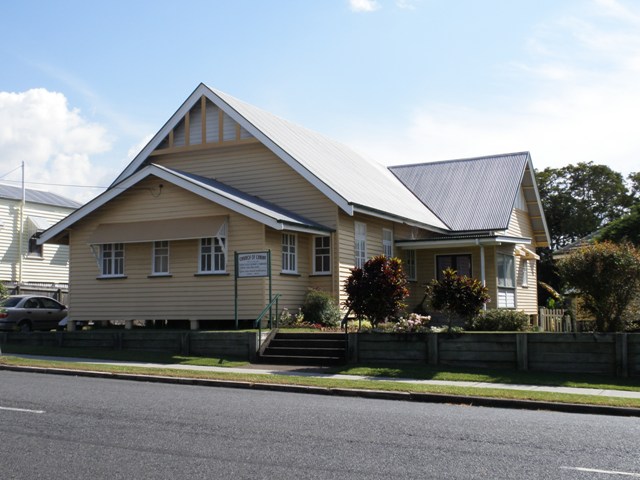

This is an image of the local heritage place known as Church of Christ
Church of Christ
Addresses
Type of place
Church
Period
Interwar 1919-1939
Style
Arts and Crafts
This building was the first Church of Christ in the Wynnum district. It was substantially constructed in one day, on 12 December 1925, after a successful ‘tent mission’ earlier that year emphasised the need for regular church services in the area. Sixty men assembled that Saturday for a working bee and the first service was held the next day. A large hall was added in March 1930 through voluntary labour.
Lot plan
L53_RP33048; L54_RP33048; L52_RP33048
Key dates
Local Heritage Place Since —
Construction
Roof: Corrugated iron;Walls: Timber
People/associations
voluntary labours (Builder)Criterion for listing
(A) Historical; (G) SocialInteractive mapping
Lot plan
L53_RP33048; L54_RP33048; L52_RP33048
Key dates
Local Heritage Place Since —
Construction
Roof: Corrugated iron;Walls: Timber
People/associations
voluntary labours (Builder)Criterion for listing
(A) Historical; (G) SocialInteractive mapping
History
Europeans first arrived in the suburb of Wynnum in the mid-19th Century, with land sales in the 1860s. By the late 19th Century, it was a seaside resort for Brisbane weekenders, prompting more commercial and residential development. As the district's population grew, churches were established to meet the community's needs. The first churches in the area were Anglican, Methodist and Catholic.
Although a Church of Christ was established on Ann Street, Brisbane, in the 19th Century, it was not until the 1920s that the church extended into the outlying shires. In November 1925, a mission in Wynnum, led by Brother E.C. Hinrichsen and Brother Brooker, resulted in 38 converts. Their success meant that a permanent place of worship was required.
At the time the church was constructed, Berrima St was known as Mary Street. The land was owned by a Robert and Jane Owens, but was mortgaged to Brother Hinrichsen in 1926.
Earlier, on 12 December 1925, about 60 men from various Churches of Christ around Brisbane gathered on-site to erect a chapel on the ground where preliminary work had been completed. Work started early in the morning, and by nightfall the church was substantially complete. Meals and provisions were provided by the church ladies. The plan for the church included a spacious auditorium, vestries, and a baptistery, with later provision for a large school hall. This one-day working bee became a successful model that the Church of Christ later used to construct its building in Kedron in 1929.
The first service was held in the new building on Sunday 20 December 1925. The congregation continued to grow throughout the 1920s and 1930s, and a ladies' guild and a Young Persons Senior Christian Endeavour were formed. A Bible School was established, as were Boys’ and Girls’ Clubs, and later the Church Cricket Teams began playing and competing.
In January 1930, a second tent mission was held by Brother E.C. Hinrichsen and Brother V. Morris, adding 57 converts to the congregation. Subsequently, in March 1930, the school hall was added to the original church building, also completed with voluntary labour.
In 1945, the title was transferred to the Conference of the Associated Churches of Christ in Queensland. By 1947, the Church and hall were free of debt, with members of the congregation foregoing some of the interest on their loans. As the congregation continued to grow, it was decided to build a manse, a decision approved in October 1947. A garage was added in 1959 and again in 1975. In 1977, a closed porch was added to the church. Church services ended in 2013 after 88 years of service to the Wynnum community.
Description
The former Church of Christ is a religious building in the Arts and Crafts style, built in the interwar years. The building is located on an irregularly shaped holding and fronts Berrima Street. Its materials, form and openings reflect its use as a religious building.
The building’s key features are its form, scale, materials and detailing. It is a low-set, timber-framed structure with a T-shaped plan, forming a nave and transepts, elevated on low square concrete stumps. The building has an intersecting, steeply pitched gable roof with eaves and an exposed timber-framed corrugated sheet-metal roof. The front elevation features a substantial projecting central gable that dominates the street presence. The building’s external walls are clad in horizontal weatherboards. The main gable features a gable infill of vertical timber members on a horizontal timber beam, while the secondary side intersecting gables feature decorative vertical timber battens set against lighter infill panels. The lower sub-floor is open, exposing the underlying structural stumps.
Entry to the site is via central concrete steps rising from pavement level on Berrima Street, leading to a path that opens onto the building's entrance, which has a lower-pitched skillion roof. This main entrance is accessed via a set of concrete stairs with metal railings and features a pair of dark-framed, multi-paned timber double doors. A secondary utility entry with timber doors is accessed via a ramp on the opposite side elevation, and there is a small lean-to room at the building’s rear. Entry to the front projecting gable is via a timber door with stairs at the side of the gable. The windows consist of single- or multi-light timber-framed casements with individual rectangular glass panes. Side windows to the nave feature two-paned transom windows above double casement windows. Most of the glass is frosted. The front-projecting bay features a tripartite bank of multi-paned casement windows, sheltered by a wide, continuous skillion hood awning supported by decorative timber brackets.
The building is set back from the road, behind a lawn accented with garden beds, mature shrubs and ornamental trees. The front boundary facing the street is defined by a low timber-sleeper retaining wall. A separate timber residential building (the manse) stands adjacent to the church. A garage is to the rear of the manse.
Significant features
Features of cultural heritage significance include:
- Form: Low-set, T-shaped single-storey religious building on low concrete stumps in the Arts and Crafts style, with a high-pitched complex gable roof form with simple gable decoration of battens and infill panels.
- Structure:
- Roof: Timber-framed corrugated sheet metal
- Walls: Weatherboards
- Openings: All original door and window openings, including timber doors and multi-paned casement windows and transom windows. Continuous skillion hood awning supported by decorative timber brackets.
- Landscape and vegetation: Landscaped garden setting with mature vegetation.
- Setting: Set back and orientation of the building. Views to and from the building from Berrima Street.
Non-significant features
Non-significant features include:
- Manse
- Garage
- Sleeper retaining wall
Statement of significance
Relevant assessment criteria
This is a place of local heritage significance and meets one or more of the local heritage criteria under the Heritage planning scheme policy of the Brisbane City Plan 2014. It is significant because:
Supporting documents
Citation prepared by — Brisbane City Council (page revised June 2026)