Addresses
Type of place
House
Period
Federation 1890-1914
Style
Queenslander
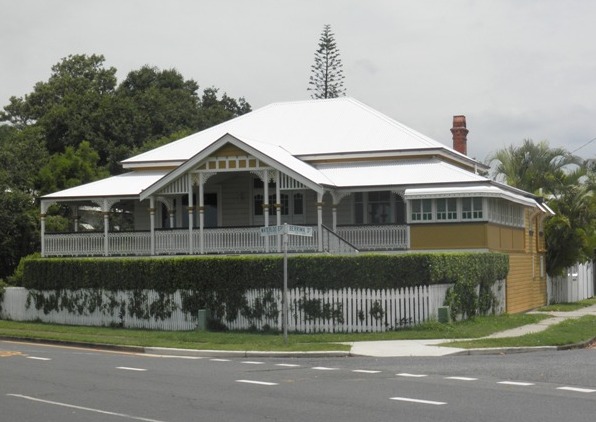

This is an image of the local heritage place known as Residence 'Britannia'
Britannia
Addresses
Type of place
House
Period
Federation 1890-1914
Style
Queenslander
This stately timber home was constructed by 1909 for members of the Sargeant family, who were part of the successful engineering and ironmongery business, A. Sargeant & Co., on Alice Street in the city. The house, named Britannia, is indicative of Wynnum’s growth in the early 20th Century and is situated on a prominent corner site overlooking Moreton Bay, reflecting the success of the Sargeant family.
Lot plan
L51_SP135623
Key dates
Local Heritage Place Since —
Date of Citation —
Construction
Roof: Corrugated iron;Walls: Timber
Criterion for listing
(A) Historical; (E) AestheticInteractive mapping
Lot plan
L51_SP135623
Key dates
Local Heritage Place Since —
Date of Citation —
Construction
Roof: Corrugated iron;Walls: Timber
Criterion for listing
(A) Historical; (E) AestheticInteractive mapping
History
Europeans first arrived in the suburb of Wynnum in the mid-19th Century, with land sales in the 1860s. Many successful businessmen and workers bought or built homes in Wynnum to enjoy the fresh sea air and beautiful views. By the late 19th Century, Wynnum was a seaside resort for Brisbane weekenders, prompting more commercial and residential development.
Britannia, built by 1909, was the home of members of the successful Sargeant family, including Henry (Harry) and Albert Henry (Henry). Harry and Henry were the son and grandson of Aaron Sargeant, who founded A. Sargeant and Co. (originally known as Harvey, Sargeant and Co., established in 1880) in 1893. The company produced ironworks, brick-making machinery, structural metal girders and agricultural machinery. Harvey, Sargeant and Company was liquidated in 1892. The company bought a block of land on Alice Street in Brisbane City and built the Britannia Foundry in 1887.
By 1930, A. Sargeant and Co. was described by The Brisbane Courier as ‘one of the oldest established and most up-to-date engineering firms in the State.’ A. Sargeant and Co. continued the reputation established by its predecessor, being known for producing a wide variety of metal goods and machinery, including iron-framed theatre seats, steam pumps, decorative and structural ironwork for many hotels in Brisbane, staircases and columns for shops and warehouses. They even made decorative columns for Government House in Paddington.
While most of their work happened in the city, the Sargeant family were active members of the Wynnum community. Harry was Commodore of the Wynnum-Manly Sailing Club in 1910 and 1911. He often umpired the Club’s boat races and once donated a £160 prize for one. Harry died in 1911 due to an accident at the Britannia Foundry, where he suffered severe head and back injuries due to a fall. Henry was also an active member of the Wynnum-Manly Sailing Club, and by 1925, he was Vice-Commodore in 1925. Henry died in 1940.
Edie Sargeant, who married Henry in 1918, was also highly engaged in local activities and groups. She was a member of the Presbyterian Church choir, one of the first members of the Wynnum Ladies’ Swimming Club and was also a keen supporter of the Wynnum-Manly Sailing Club.
Britannia remained in the Sargeant family until the late 1970s and remains a private residence.
Description
Britannia is a high-set, single-storey Queenslander-style residence from the Federation period, built on a prominent corner lot fronting Waterloo Esplanade in Wynnum, with views across Moreton Bay. Its materials, form, openings and scale reflect its use as a residence.
Key features of the building include its chamferboard cladding, high-pitched roof form, wrap-around verandah, a projecting pediment over the verandah entrance, and a prominent brick chimney. The building is high-set on stumps and features a high-pitched, timber-framed, corrugated sheet-metal hipped roof above a stepped verandah roof. It is clad with a mix of chamferboards and VJ boards. The understory is enclosed with a mix of chamferboard, vertical timber battening, lattice panels and bricks.
The front elevation of the house features a prominent entry bay with a projecting gable roof with decorative timber battening and infill panels. This transitions to a pitched, stepped, wrap-around verandah that is open on the northeast (front elevation) and the southeastern side of the house. A gable-roofed semi-attached building at the rear of the house features a prominent brick chimney and a lattice-screened small verandah at the rear. The chimney consists of multi-toned red clay face bricks, a brick crown with corbel details, and 3 arched brick cowls.
The verandah consists of a timber balustrade with filigree infills and chamfered timber posts with moulded capitals and bases, and filigree brackets. Entry to the building is through a panelled, painted timber door, accessed via the verandah by timber stairs to the right of the projecting gable. Openings include a mix of multi-paned casement or double-hung windows. Several windows feature transoms.
The right, left, and rear elevations feature window skillion hoods of corrugated sheet metal with either filigree metal brackets or timber brackets. A prominent convex-shaped hood of corrugated sheet metal that frames the front right-hand corner of the building.
The building is framed by a timber picket fence, with a mature, formal hedge at the front for privacy. The rear garden contains a pool, while the understory has been converted into a garage beneath the building, with entry via a weatherboard garage door on the Berrima Street frontage.
Significant features
Features of cultural heritage significance:
- Form: High-set, single-storey residence in the Queenslander style with a high-pitched hipped roof form, wrap-around verandah with stepped roof and front gable-roofed entry bay with decorated pediment. Semi-attached building at rear with a gable roof, face brick chimney, and rear lattice screened verandah.
- Structure:
- Roof: Timber-framed corrugated sheet metal.
- Walls: Mix of VJ boards and chamferboards.
- Verandahs: L-shaped verandah with a stepped pitched roof, timber floors, cast iron filigree balustrade and chamfered timber posts with cast iron filigree brackets.
- Openings: All original door and window openings, including panelled painted door, a mix of casement and double hung sash windows, transom windows, skillion hoods with a mix of cast iron filigree and timber brackets, and a continuous convex-shaped tin windowhood.
- Key features and elements: Multi-toned red clay face brick chimney with a projecting brick corbel creating a defined collar topped by concrete with three interconnected, miniature gables.
- Setting: Setback and orientation of the building from Waterloo Esplanade. Views to and from the building from Waterloo Esplanade and Berrima Street. Views towards Moreton Bay.
Non-significant features
Non-significant features include:
- Swimming pool
- Landscape and vegetation.
Statement of significance
Relevant assessment criteria
This is a place of local heritage significance and meets one or more of the local heritage criteria under the Heritage planning scheme policy of the Brisbane City Plan 2014. It is significant because:
Supporting documents
prepared by — Brisbane City Council (page revised June 2026)